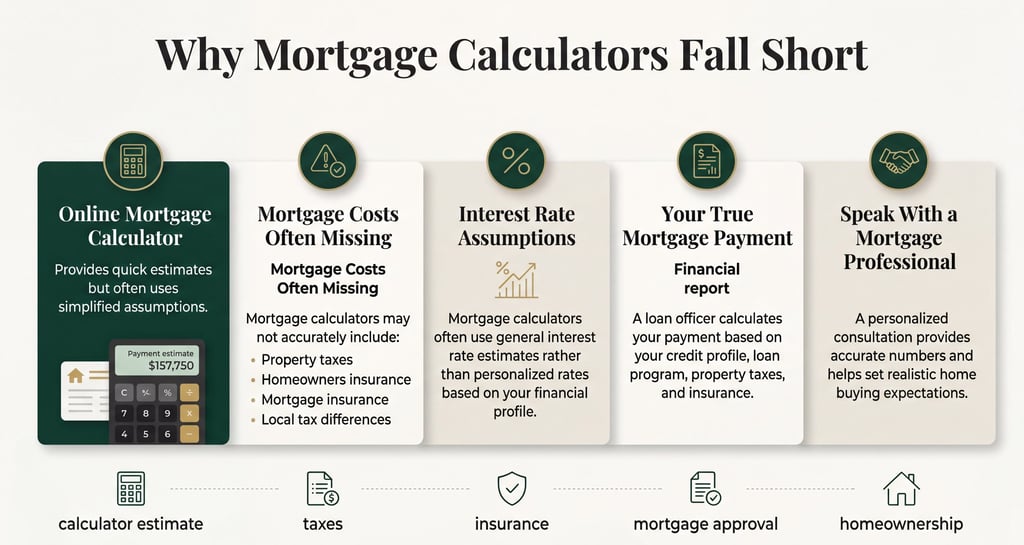
Why Mortgage Calculators Fall Short
Why Speaking With a Loan Officer First Can Save You From Costly Surprises
Why Online Mortgage Calculators Are Often Inaccurate
And Why Speaking With a Loan Officer First Can Save You From Costly Surprises
If you're thinking about buying a home, one of the first tools you may turn to is an online mortgage calculator.
Mortgage calculators are extremely common and can be useful for rough estimates, but they often fail to reflect the true cost of homeownership.
Many buyers begin their home search based on these numbers, only to discover later that their actual mortgage payment is very different.
Setting the correct expectations early in the home buying process is one of the most important things you can do to avoid frustration later.
Let’s break down why mortgage calculators frequently fall short and what you should do instead.
Are Mortgage Calculators Accurate?
The short answer is not always.
Mortgage calculators typically rely on simplified assumptions and generic data inputs. While they can provide a basic estimate, they often fail to account for several important factors that influence your actual monthly mortgage payment.
These tools typically calculate only:
Purchase price
Down payment
Interest rate
Loan term
However, a true mortgage payment often includes many additional costs that calculators do not estimate correctly.
What Mortgage Calculators Often Get Wrong
When borrowers search online for “how much house can I afford” or “mortgage payment calculator,” they are often shown simplified estimates that don't reflect the full financial picture.
Here are some of the biggest reasons these estimates can be inaccurate.
Property Taxes Are Frequently Estimated Incorrectly
Property taxes vary significantly depending on:
City or county
Local tax rates
Property assessments
Changes in tax laws
Many online calculators use national averages or outdated tax data, which can make payment estimates inaccurate.
For example, if property taxes are underestimated, a calculator might show a monthly payment that is hundreds of dollars lower than reality.
An experienced loan officer reviews the actual property tax structure for the specific area you are buying in.
Homeowners Insurance Is Often Underestimated
Mortgage calculators frequently use simplified assumptions when estimating homeowners insurance.
However, insurance costs vary depending on:
Property value
Location
Insurance provider
Coverage requirements
Risk zones such as flood areas
Without these details, calculators often provide estimates that do not match real insurance premiums.
Mortgage Insurance May Not Be Included
Depending on the loan program you choose, your payment may include mortgage insurance, which calculators often fail to include properly.
For example:
FHA Loans
Include both upfront mortgage insurance and monthly mortgage insurance premiums.
Conventional Loans
May require Private Mortgage Insurance (PMI) depending on the down payment.
VA Loans
Include a funding fee that can impact your loan structure.
Each program has unique guidelines, which is why generic calculators struggle to provide accurate estimates.
Interest Rates Change Frequently
Mortgage interest rates move daily and sometimes multiple times throughout the day depending on market conditions.
Many calculators assume a static interest rate, which may not reflect current market pricing.
Your interest rate depends on several factors including:
Credit score
Loan program
Down payment
Loan size
Market conditions
This is why two borrowers purchasing similar homes may receive different mortgage rates.
Why Incorrect Estimates Can Create Problems During the Home Search
When buyers start their home search based on unrealistic payment estimates, it can lead to frustration later.
For example:
A mortgage calculator might estimate a payment of $2,500 per month.
However, after accounting for taxes, insurance, and mortgage insurance, the true payment could be closer to $2,900 per month.
That difference can change:
Your home search price range
Your monthly affordability
Your financial comfort level
Your DTI Ratios in which an increase here could negatively impact your qualifying factors
Starting with accurate numbers helps avoid this situation.
Why Speaking With a Loan Officer First Is the Best Approach
Instead of relying solely on mortgage calculators, speaking with an experienced loan officer can provide a much clearer picture of what your true mortgage payment may look like.
A professional mortgage consultation evaluates factors such as:
Credit profile
Income structure
Debt-to-income ratio
Loan program eligibility
Property tax estimates
Insurance costs
Current mortgage interest rates
This creates a customized payment estimate based on real numbers, not generic assumptions.
Setting the Right Expectations From the Beginning
Buying a home should feel exciting and empowering, not confusing or stressful.
When you begin the process with clear financial expectations, you can focus on finding the right home rather than adjusting your plans later.
Accurate planning makes the home buying journey smoother for everyone involved.
Speak With a Mortgage Professional Before Relying on Online Calculators
If you are considering purchasing a home in Virginia, Maryland, or Washington DC, having an experienced mortgage professional guide you through the numbers can make a significant difference.
At Aurelium Home Loans, I offer no-obligation consultations where we review your financial goals and discuss what your potential mortgage payment may look like based on real data.
You are always welcome to reach out with questions.
Want to Know What Your Real Mortgage Payment Could Be?
Schedule a conversation and receive a personalized estimate based on your financial profile and current market conditions.
- Jake Bumbrey Jr-
Licensed MLO: NMLS #2603530 (VA)
© 2026 Aurelium Home Loans. All rights reserved.


Powered by: