Aurelium Home Loan's Mortgage Process Timeline
The Complete 21-Step Mortgage Loan Process in Virginia, Maryland & Washington DC
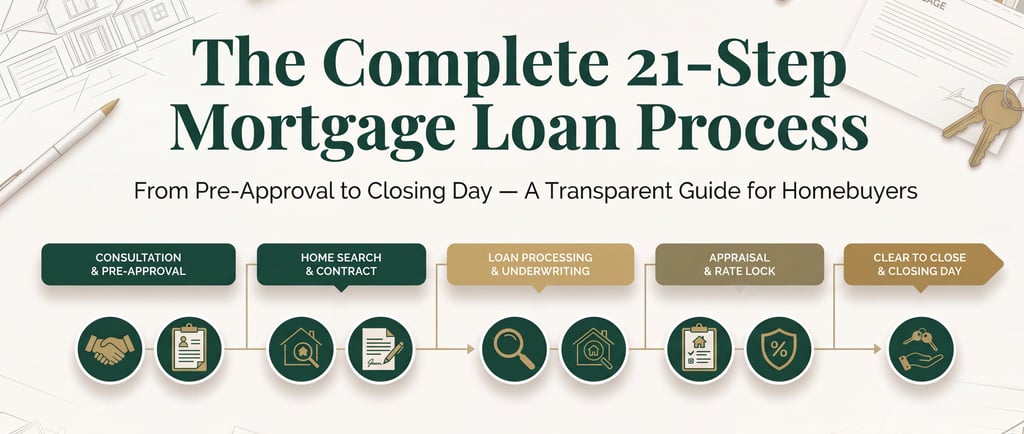
The Complete 21-Step Mortgage Loan Process in Virginia, Maryland & Washington DC
What to Expect When Working With a Mortgage Lender
Buying a home is one of the largest financial decisions you will ever make.
If you’ve been searching for:
how the mortgage process works
steps to buying a house
how to get pre approved for a mortgage
what happens after going under contract
This guide walks you through every stage of the mortgage loan process from consultation to closing.
At Aurelium Home Loans, transparency is foundational. You deserve to know exactly what happens next — at every step.
Step 1 – Discovery Consultation Before Credit Is Pulled
One of the most important steps in the mortgage process is the initial consultation.
Before running credit, a licensed mortgage loan officer should:
Evaluate your financial goals
Review your income structure
Assess your current credit position
Determine whether your goals align with lending guidelines
You should never have your credit pulled “just because.” If a lender asks you to complete a mortgage application without first discussing strategy, that is a red flag.
This step protects you and ensures we move forward intentionally.
Step 2 – Mortgage Pre-Approval Application & Document Review
Once we determine you are ready to move forward, you will complete a formal mortgage pre-approval application.
During this stage:
A soft credit pull is completed
Income and asset documentation is reviewed
Interest rate strategy is discussed
Premiums and lender credits are evaluated
Required disclosures are signed
If you are searching for “how to get pre approved for a mortgage,” this is where it officially begins.
Step 3 – Initial Underwrite & Official Mortgage Pre-Approval Letter
After I have fully assessed your unique credit profile, I will personally structure your loan file and officially submit it to our in-house underwriting department for official review. Durning this time the underwriter reviewing your file may have additional questions or request additional documentation. This is very routine durning the loan process and does not mean that there is anything wrong. The faster we get these items back to the underwriter, the faster we can receive the pre-approval, so I will work very closely with you durning this process to make sure that it goes as smoothly as possible for you.
Once the official review has concluded, if approved, you will receive a formal pre-approval letter designed specifically for you that will directly reflect your buying power to strengthen your offer in competitive markets like Virginia, Maryland, and Washington DC.
Step 4 – Begin Your Home Search With Strategic Clarity
Once your structured pre-approval is issued, you can confidently begin shopping for your future home.
At this stage:
You know your maximum purchase price.
You understand your estimated monthly payment.
You know your projected cash-to-close.
You understand your interest rate strategy options.
This allows you and your real estate agent to write offers with confidence rather than uncertainty.
In competitive markets like Virginia, Maryland, and Washington DC, clarity and speed matter. A properly structured pre-approval gives sellers confidence that your financing is strong and realistic.
Step 5 – Ratified Contract & Formal Loan Activation
Once your offer is accepted and the contract is ratified, the official lender process begins.
At this stage:
A hard credit inquiry is completed.
Your file is submitted through the Automated Underwriting System (AUS).
Credit report fees are paid directly by the borrower through a secure link.
The purchase contract is reviewed in detail.
The AUS evaluates your financial profile against agency guidelines (Fannie Mae, Freddie Mac, FHA, VA, etc.) and issues an approval recommendation.
This step officially transitions your file from pre-approval to full mortgage processing.
Step 6 – Official Loan File Submission to the Lender
Your loan file is formally submitted to the selected lender.
During this time:
Your borrower portal is created.
Your file is indexed within the lender’s system.
Your loan is assigned internally for underwriting.
Portal configuration can take 5–7 business days depending on the lender. However, your file is actively being worked on during this time. There is no pause in processing.
Your documentation is reviewed and organized to ensure a clean underwriting submission.
Step 7 – Loan Estimate & Initial Disclosures
After submission, you will receive your official Loan Estimate (LE).
This document outlines:
Interest rate
Annual Percentage Rate (APR)
Lender fees
Estimated closing costs
Estimated cash to close
Loan program details
You must electronically acknowledge these disclosures to move forward.
It is extremely important to review this document carefully. I walk each client through the Loan Estimate to ensure complete understanding of the numbers.
Transparency at this stage eliminates confusion later.
Step 8 – Initial Underwriting Approval
During this step, your file is actively assigned to the lenders underwriting department and an underwriter is currently assigned to your file to review.
The underwriter evaluates:
Income calculation accuracy
Employment consistency
Asset verification
Debt-to-income ratios
Property eligibility
Credit profile
An initial approval is typically issued at the conclusion of this step with conditions, if any. Conditions are normal and expected in nearly every mortgage file.
Step 9 – Underwriting Conditions & Documentation Requests
Conditions may include requests such as:
Updated pay stubs
Clarification on deposits
Additional bank statements
Letters of explanation
Employment verification updates
These requests are not red flags. They are part of responsible risk management. This is where organization and preparation earlier in the process pay off significantly. Fast response times here are absolutely critical, as the faster we are able to gather all required documentation and return it back to the underwriter, the faster we can move towards getting you the "Clear to Close" as quickly as possible.
Step 10 – Loan Processor Introduction
At this step in the process, your loan processor is officially introduced to you.
Their role and responsibilities within your transaction include:
Collecting requested documentation
Reviewing condition submissions
Communicating with underwriting
Ensuring timelines are maintained
Think of your processor as the operational backbone of your loan once you have been submitted officially to a lender for processing.
Step 11 – Home Inspection
Your home inspection typically occurs within the first 7 days of receiving a ratified contract. Durning this time, your loan file is also in its initial underwrite phase as well with the lender.
The inspection evaluates:
Structural integrity
HVAC systems
Plumbing and electrical
Roof condition
Safety issues
While the lender requires an appraisal, the inspection protects you as the buyer. This step allows you to negotiate repairs or credits if needed.
Step 12 – Contract Addendums (If Applicable)
If negotiations occur after inspection, such as:
Seller-paid repairs
Price adjustments
Seller concessions
An addendum is signed and submitted to the lender. All contractual updates must be reflected in the mortgage file to maintain compliance and accuracy.
Step 13 – Appraisal Ordered
Once the home inspection process has concluded, it is now time to order this appraisal. As the borrower, you will receive an invoice from the mortgage broker for the appraisal and once payment has been received, we will officially order the appraisal for your property.
The appraisal determines:
Fair market value
Property condition
Compliance with loan guidelines
The appraiser is independent and cannot be influenced by buyer, seller, or lender. This protects all parties involved.
Step 14 – Interest Rate Lock
Once you have been initially approved with the lender and your account portal has been successfully configured by the lender we are now ready to lock your interest rate.
Locking your rate:
Protects against market volatility
Secures your pricing
Finalizes your loan structure
Timing the rate lock depends on:
Market conditions
Contract timeline
Risk tolerance
Loan program type
This decision is strategic and discussed thoroughly.
Step 15 – Appraisal Review & Valuation Confirmation
Once the appraisal is received back from the assigned appraiser, the lender will review for accuracy. If the property appraises at or above the purchase price, we proceed normally.
If it appraises below value, options may include:
Renegotiating price
Bringing additional funds
Filing a reconsideration of value
Each scenario is handled carefully and strategically.
Step 16 – Clearing Final Underwriting Conditions
As remaining conditions are satisfied, your loan file continuously moves toward final approval.
At this stage:
All income documentation is finalized
All asset sourcing is verified
Final WVOE's are being completed
Employment verifications are completed
Compliance checks are confirmed
Your loan file is actively being prepared for final sign-off with the lender.
Step 17 – Initial Closing Disclosure (ICD)
As we approach the "Clear to Close" you will receive your Initial Closing Disclosure which is needed at least 3 business days prior to your closing date per federal law.
Important notes:
It is extremely common for numbers on the ICD not to be 100% exact as numbers on the ICD may still fluctuate slightly while title and the lender balance final figures.
Prepaid items such as interest, taxes, and insurance may adjust.
Lender-observed holidays can affect the timing of this delivery.
We plan carefully to avoid delays. I walk you through every line item so there is complete clarity.
Step 18 – Clear to Close
Congratulations you have officially been granted a Clear to Close which means:
All underwriting conditions have been satisfied.
The lender has approved your loan for funding.
No further documentation is required.
This is is a huge accomplishment but it is extremely important that even though you have been granted a "Clear to Close" it is not a guarantee to lend money. 1%-2% of loans don't make it to closing after receiving the "Clear to Close" so it is extremely important to not have any more debt or credit inquiries occur after you have received a "Clear to Close".
Step 19 – Title & Lender Final Balancing
Durning this step, The lender and title company reconcile:
Final payoff figures (if applicable)
Final cash-to-close amount
Recording fees
Escrow adjustments
Accuracy here ensures your closing documents are correct.
Step 20 – Closing Documents Generated
At this time in the process, the lender generates your final closing documents and sends them to the title company.
You will typically receive:
Final Closing Disclosure
Promissory Note
Deed of Trust
Various state-specific documents
You may receive a preliminary copy for review before signing.
Step 21 – Closing Day
You have officially made it to closing and you are ready to take possession of your new property. On closing day:
You sign your final documents.
Funds are disbursed.
The deed is recorded.
You receive your keys to your brand new home.
At this point, you officially become a homeowner.
Why Understanding the Mortgage Loan Process Matters
When borrowers understand the steps of the mortgage process:
Stress decreases
Confidence increases
Surprises are minimized
Decisions become clearer
If you are looking for a mortgage lender in Virginia, Maryland, or Washington DC who prioritizes transparency, structure, and communication, Aurelium Home Loans is built for you.
Ready to Start the Mortgage Pre-Approval Process?
If you’re searching for:
mortgage lender near me
VA loan lender
FHA loan lender
first time home buyer mortgage
mortgage broker in Virginia, Maryland, or DC
Let’s build your mortgage strategy correctly from day one.
- Jake Bumbrey Jr-
Licensed MLO: NMLS #2603530 (VA)
© 2026 Aurelium Home Loans. All rights reserved.


Powered by: